
Jackson County Projected vs Actual
IDOC uses exact labels with different meanings. “Projected Parole Date” estimates anticipated physical exit from prison to parole or mandatory supervised release. “Projected Discharge Date” estimates the later end of sentence or supervision. After prison exit, an actual “Parole Date” may replace the projected parole field. Calling the discharge estimate a prison-release date creates a serious timing error.
A Jackson County Jail release uses a different record system. A sentenced person may have a computed local date, but Jackson County publishes no online projected-date field or local good-time policy. A pretrial detainee has no sentence-based date. A judge may enter a release order, yet processing, another case, or a detainer can delay or prevent community release.
Find Jackson County Projected Release
Choose the channel by custody type. IDOC projections belong only to state-prison records. A Jackson County criminal case can lead to IDOC, but that does not make the county jail an IDOC facility. Match the person with an IDOC number, birthdate, case number, booking number, or other reliable identifier.
- For state prison, open the IDOC inmate search and use last name, IDOC number, or birthdate.
- Read Offender Status and Location together. Then locate Projected Parole Date, Projected Discharge Date, and every sentencing row.
- For Jackson County Jail, inspect the county Judici docket for the sentence, custody credit, release order, mittimus, or warrant.
- Call Jackson County Jail at 618-687-2292 and request the proper records path for the jail computation and holds. Obtain the sentencing or release record when precision matters.
- If a transfer appears, continue in the receiving system. A Jackson County exit to IDOC, another jail, USMS, or ICE is not a community release.
The full Jackson County release verification path reconciles the court's authority with the custodian's actual timestamp. Save the research date because IDOC warns that its information changes quickly.
Illinois Credit Shapes Release Dates
730 ILCS 5/3-6-3 supplies the sentence-credit framework. Identified first-degree murder and terrorism sentences receive no sentence credit and serve 100 percent under the cited provision. Enumerated serious offenses are limited to 4.5 credit days per month, often summarized as about 85 percent service. Certain listed drug, gunrunning, and money-laundering offenses are limited to 7.5 days per month, about 75 percent. Other eligible offenses generally receive one day of sentence credit for each day imprisoned, often summarized as 50 percent.
Those percentages are categories, not a personal calculator. The exact offense, offense date, statutory subsection, injury finding, prior conviction, sentence length, and eligibility can change the result. Natural-life terms receive no sentence credit. IDOC, not a public estimate, performs the authoritative calculation.
The statute also permits discretionary earned credit, with limits tied to sentence length and eligibility, plus qualifying program or educational credit. Presentence custody credit, concurrent or consecutive terms, every mittimus, credit loss or restoration, and later orders also affect the displayed date. A sound conceptual flow is: sentence → presentence credit → statutory category → eligible earned credit → later events → supervision term.
Why Jackson County Dates Change
A projection reflects the facts and rules then loaded into the custodian's system. It can move when IDOC receives a corrected mittimus, applies or removes eligible credit, records discipline, recalculates consecutive sentences, or responds to a later court order. A detainer may not change the end of one sentence but can change whether the person enters the community.
| Event | Possible effect | Record to check |
|---|---|---|
| Credit earned, lost, or restored | Moves the estimate under applicable law | IDOC detail and written verification |
| Corrected sentence or custody credit | Changes the calculation base | Court order, mittimus, IDOC rows |
| Concurrent or consecutive terms | Changes how multiple sentences combine | All sentencing rows and judgments |
| Detainer or transfer | May end one custody but continue another | Release destination and receiving locator |
| Violation or revocation | May produce a newly calculated date | PRB result and updated IDOC status |
A past projected date paired with an in-custody status does not prove an overdue release. Current status controls the present-custody answer until IDOC explains the conflict.
Confirm Jackson County Release Dates
Illinois VINE can send a source-specific custody or case notification after the correct person and reporting agency are matched. Register through the Illinois VINE service by phone, text, email, or app. A release or no-longer-in-custody notice applies to that reporting feed. It does not rule out transfer to IDOC, another jail, federal custody, immigration custody, or another agency.
Use VINELink Inmate Search for notice, then confirm through the originating record. For Jackson County Jail, request the release date/time, authority or type, and transfer destination when disclosable. For IDOC, compare status, location, actual Parole Date, projected fields, and sentence rows. Consequential or internally inconsistent details should be verified in writing with IDOC Public Information Office.
After the physical exit, the record should shift from projection to history. A county release sheet supplies the processed timestamp. An IDOC actual Parole Date with PAROLE status supports prison exit to supervision. Neither fact by itself means the whole sentence has ended.
Which Illinois Release Date Matters?
Jackson County users can encounter two forward estimates on the same IDOC detail page. Projected Parole Date is tied to expected prison exit. Projected Discharge Date is tied to expected completion of sentence or supervision. The distinction remains important after release because the record can show an actual Parole Date and a future discharge estimate at once.
Read all fields as a set. Offender Status PAROLE, a parole-district Location, and an actual Parole Date strongly support release from IDOC custody to supervision. A future Projected Discharge Date shows that legal supervision is expected to continue. “Sentence Discharged? yes” applies to its particular sentencing row, so review every row before describing final discharge.
Jackson County Jail Date Limits
Jackson County has published no local online projected-date field and no local good-time policy. For a county sentence, the sentencing order, lawful custody-credit computation, jail calculation, other holds, and court authority control. Importing an IDOC Projected Parole Date into a person who never entered state prison would be inaccurate.
Ask the jail for the computed date and known holds, then obtain the existing sentencing or release record instead of asking staff to create a legal calculation. The Jackson County Sheriff's Office is at 1001 Mulberry Street, Murphysboro, and its main number is 618-684-2177. Civil Process/Records and administration publish weekday hours of 8 a.m. to 4 p.m., with closure from noon to 1 p.m.
When the court order date and actual exit differ, state both. The order authorizes release; the jail record documents processing. If the destination says IDOC or another custodian, describe the event as a transfer.
Illinois Parole Hearing Limits
Most modern determinate Illinois prisoners do not receive a traditional discretionary parole-grant hearing. Under 730 ILCS 5/3-3-3, legacy parole eligibility follows older sentencing law, while modern determinate terms generally lead to MSR under sentence-credit rules. Eligible youthful review has its own statute and exclusions.
That is why a missing name from a PRB en banc calendar does not erase an IDOC projected date. MSR length varies by offense and class under 730 ILCS 5/5-8-1(d), so no single supervision duration should be attached to every Jackson County case. Use the IDOC record for the projection and the PRB record only when a relevant hearing or decision exists.
The IDOC live search choices show the official name, number, and birthdate entry routes.
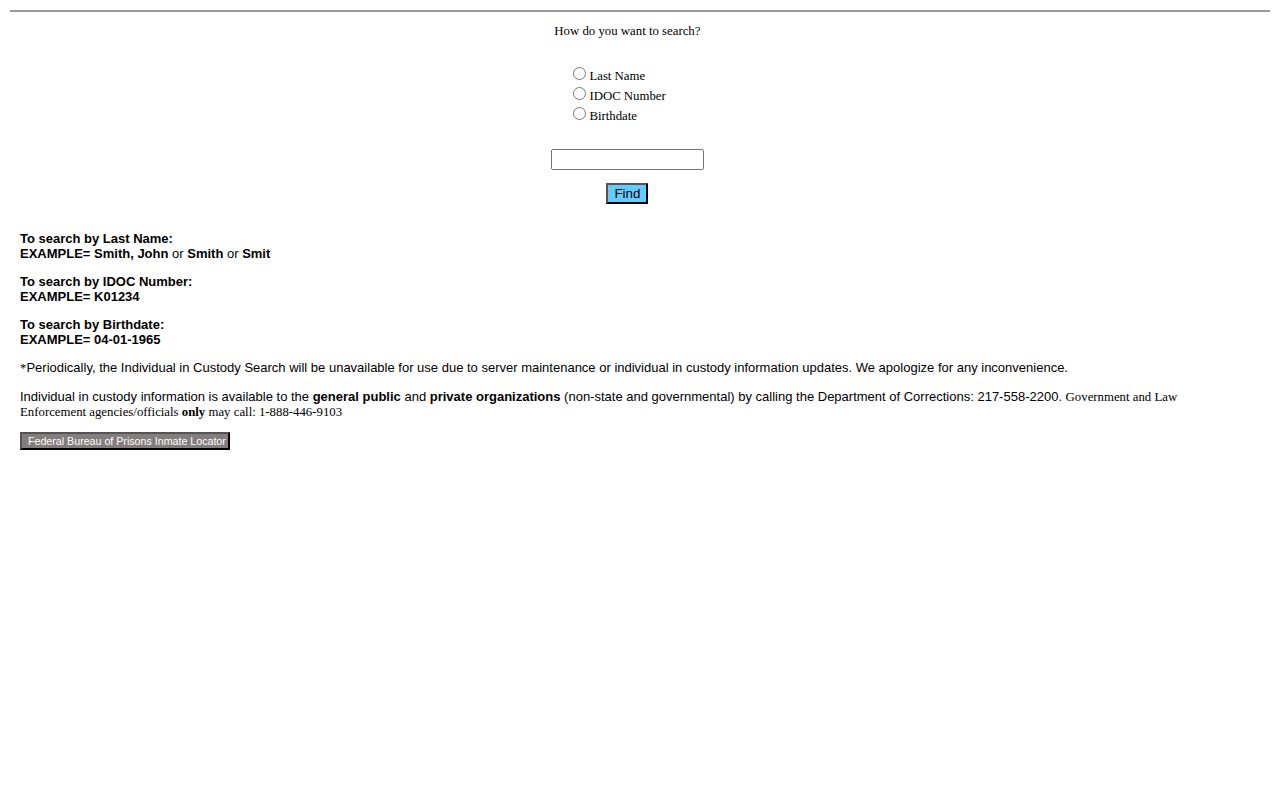
The captured interface identifies the state search route; the matching detail record and later written verification control the individual estimate.
Jackson County Release Date Terms
IDOC fields must be matched to the event a reader is trying to confirm. An Admission Date marks an entry associated with the correctional record. It is not a release date. Parent Institution can identify an administrative institution, but it should not be assumed to be the person's present physical location without reading Location and Offender Status. A sentencing row also carries a mittimus or case number, offense information, sentence, county, and a “Sentence Discharged?” entry. Those details help connect an IDOC result to the correct Jackson County case.
- Projected Parole Date
- IDOC's changeable estimate for anticipated prison exit to parole or MSR. The field can show “INELIGIBLE” in applicable circumstances.
- Parole Date
- The historical date shown after release to supervision. It does not establish final discharge.
- Projected Discharge Date
- The estimated end of the sentence or supervision, not the estimated prison-door date.
- Offender Status
- IDOC's current high-level status. Read it with Location and all displayed dates.
- Mittimus
- The court commitment material connecting the judgment and case to correctional custody.
Every sentencing row matters. “Sentence Discharged? yes” on one row does not prove all other sentences or supervision have ended. Likewise, an IDOC record may display “INELIGIBLE” instead of a projected date. That label should be reported as shown, not converted into a guessed date. When a public detail record appears incomplete or internally inconsistent, request the exact fields in writing from IDOC Public Information Office rather than calculating around the missing information.
Jackson County Parole Decision Dates
A PRB calendar is evidence that a hearing was scheduled, not proof that release occurred. Institution liaisons prepare monthly dockets, and the Board conducts hearings by video. The annual en banc schedule covers full-Board dates for eligible youthful and legacy indeterminate matters. Posted decision PDFs can include the IDOC number, controlling offense, hearing date, vote, parole date, denial information, and institution, but publication may lag the event.
Revocation materials answer a different question. Monthly schedules can change during the week before a facility date. Final-hearing results may show continued or returned release, no violation followed by release after plan approval, or revocation that leads IDOC to calculate a new release date. Compare the decision with the updated IDOC detail record. If the two sources disagree, current custody status controls the immediate answer while written verification resolves whether a projection changed, a decision remains unprocessed, or another legal event intervened.
Public Record Search
Sponsored Results